Fifty Years Ago, or The Cabins of the West
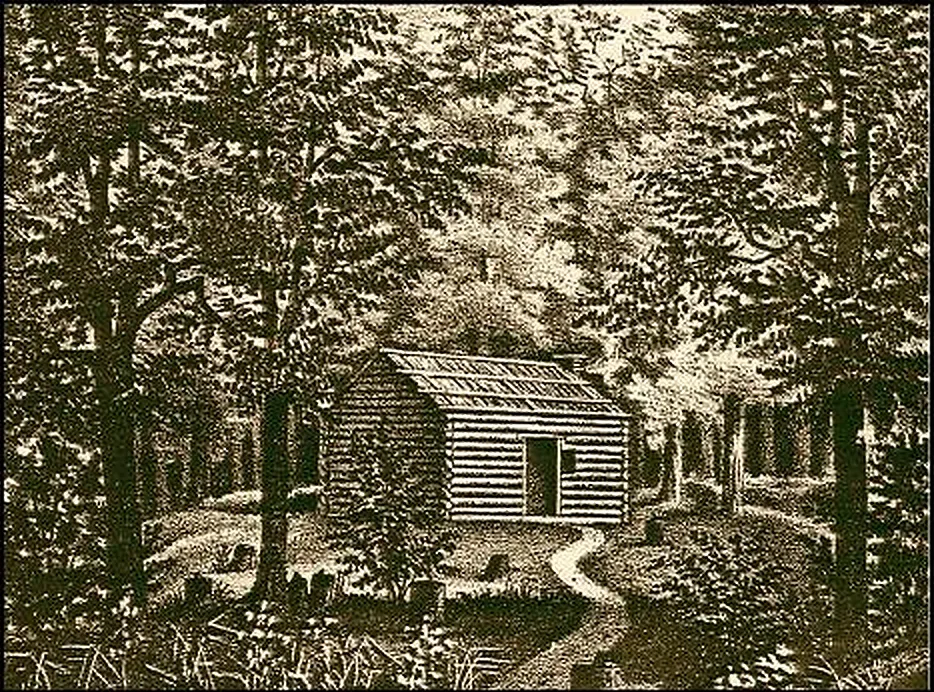
This was the first of the three frontier series, printed through 1875 in volume 43 of Arthur's Home Magazine, one installment a month. The title does the arithmetic for you: fifty years back from 1875 is the 1820s, the decade when Rosella Rice was born and Green Township was still mostly woods. She opens several pieces standing on the ruined hearthstones of some cabin and then lets the story come out of them.
The twelve numbers vary a great deal. Some are melodrama, with a counterfeiters' cave, a faithless husband and a girl who seems born for trouble. Others are straight recollection. Coming to Ohio and Father's Stories are her father Alexander Rice talking about the family's seven week trip from Essex County, New York, in 1810 and the first hungry years near Perrysville. The eleventh number records his visit to a Delaware festival at Greentown in 1811 and the months the settlers spent in a blockhouse in 1812.
Taken together they are an inventory of early Ohio: how a cabin and a log schoolhouse were built, what people ate, what a hunting shirt looked like, how much a schoolmaster earned and in what, and how whisky, witchcraft, Methodist hymns and hard work sat side by side in the same small rooms.
Contents
- No. 1Poor Kitty Sommersp. 1p. 2
- No. 2The Old Pettingill Farmp. 1p. 2
- No. 3First Day of Schoolp. 1p. 2
- No. 4Tom and Bessiep. 1p. 2
- No. 5Frontier Neighborsp. 1p. 2
- No. 6Coming to Ohioone page
- No. 7Father’s Storiesone page
- No. 8A Sing’lar Girlone page
- No. 9Rich in Dogsone page
- No. 10Gran’ther and the Witchone page
- No. 11Log School, Blockhouse and Indian Villageone page
- No. 12Uncle Harry off to the canalone page
No. 1. Poor Kitty Sommers
Kitty Somers marries Job at seventeen and sets up house in a fourteen-by-sixteen log cabin by the creek. Page 1 follows their hard first years, a child’s death at the spring, and Job’s drift toward Squire Gardiner.
No. 2. The Old Pettingill Farm
A homesick young woman befriends Aunt Mary on the old Pettingill farm, and Mary’s early years as a pioneer wife unfold: the cabin, her husband Henry, a night with Johnny Appleseed, and the widow Salome Chester.
No. 3. First Day of School
Five-year-old Billy Crosby dreads his first day at the log school, where Asa Brown is master. Page 1 sketches the poor Crosby cabin, the handy man Aaron Crosby, and how a backwoods school was run.
No. 4. Tom and Bessie
Page 1: Tom Lawson and Bessie Carnahan become engaged after a husking at Judge Lee’s, with a preaching in the barn, Tom asking her father’s consent, and Bessie’s linen and quilts for the new cabin.
No. 5. Frontier Neighbors
Rusha Punderson hears that a poor Virginia family has settled nearby and rides over with a gift of linen. Page 1 follows the first visit, the dinner, and the neighbors’ return call.
No. 6. Coming to Ohio
Rosella’s father recalls the 1810 to 1811 move from Willsborough, New York, across Pennsylvania to Newark and then to the Ohio farm, with Granny Benjamin’s Revolution talk and the family on the road.
No. 7. Father’s Stories
At breakfast grits send Rosella’s father back to 1811 and 1812: pounding corn without salt, three families in one cabin on Uncle Solomon Hill’s land, and sketches of circuit preachers and neighbors.
No. 8. A Sing’lar Girl
From a hilltop, Aunt Cook recalls Esther Caldwell, a weaver whose cabin stood in the ravine. Rosella visits the site and tells her life of loss, from a kiln fire to a baby drowned in the well.
No. 9. Rich in Dogs
Jack Howell courts Peggy Watson in a one-room cabin under the eyes of her whole family, her sister Lydia plays a trick with a pie, and a circuit-preacher wedding follows, with Jack proud of his dogs.
No. 10. Gran’ther and the Witch
Beside a hill where the poor Franks family once lived, Gran’ther Jones is asked to judge a suspected witch. The story follows the neighbors’ fear of Goody Leet and her sale as a pauper in 1813.
No. 11. Log School, Blockhouse and Indian Village
Standing on the site of a vanished log school-house, the writer recalls its pupils, the blockhouse where families fled from Indians, and the nearby Greentown village, ending with relics found there.
No. 12. Uncle Harry off to the canal
On the site of her family’s first cabin, Rosella remembers Uncle Harry, who left with his friend Will to work on the canal, and the grief that followed when he never came home.
Questions
Why do several stories run to two pages?
The original site split the longer installments across two pages, and the page breaks have been kept so the old addresses still work. Each second page is linked from the first.
Are the people in these stories real?
Some are. Alexander Rice appears as the narrator's father, whom the neighbors call Alex, and the Hill and Adsit families who shared a cabin with the Rices in 1811 are named in Coming to Ohio. Asa Brown, the schoolmaster of the third number, is recorded as teaching the first Perrysville schoolhouse in 1816. The counterfeiters, the Pettingills and most of the courting couples we could not trace, though Rice tells several as neighborhood tales.
What does the magazine citation look like?
Arthur's Home Magazine, volume 43, 1875. The bibliography page lists the page numbers of all twelve installments.